Cameras & Creators · Comparison
The kitchen has become the studio. The counter is the desk, the hob is out of shot, and the only light comes from a window above the sink and a strip of downlights on the ceiling. Filming happens after dinner, when the window is black and the downlights turn every surface into a hard, unflattering shine. That is the situation a first light is meant to fix.
Most beginners start by comparing brightness. The more useful comparison is what each light does to shadows, because that is what actually changes how the shot looks.
Ring lights: even, flat and shadowless
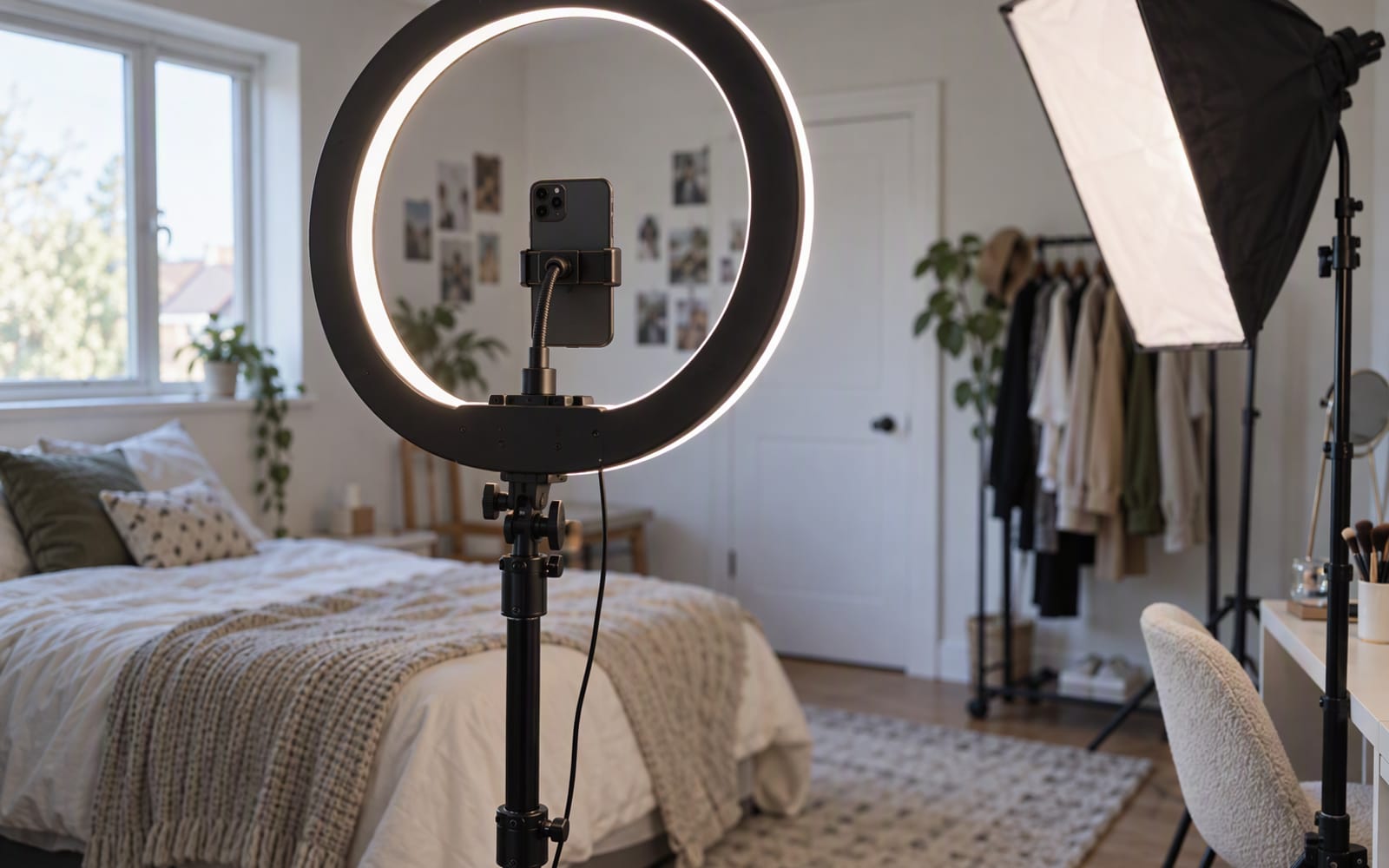
A ring light is a circular light with a hole in the middle, positioned so the camera looks through it. Because the light comes from all around the lens, it throws almost no shadow on the face. Skin looks smoother, eyes catch a bright circle, and the result is even and consistent.
That consistency is the appeal. A ring light on a stand gives you the same look in the kitchen, in a hotel room, or in a spare bedroom, at any hour. It is also simple: one stand, one plug, one dial.
The cost is that flatness. With no shadow to describe the shape of a face, the image looks two-dimensional. That is a deliberate look, and for talking-head video and makeup it is often exactly what you want. For anything where you want depth, it works against you.
Softboxes: directional light you can shape
A softbox is a box with a diffusing front panel that fits over a light source. It makes the light large, and a large light source relative to the subject produces soft-edged shadows rather than hard ones. The difference from a ring light is direction: the softbox sits to one side, so it lights one side of the face more than the other and creates the shadow that gives the image depth.
That is the whole argument for a softbox. It does not make the light brighter or softer in the abstract — it lets you decide where the light comes from and therefore what the scene looks like. Move it closer and the light gets softer and falls off faster. Move it further away and the light becomes harder and more even. Those two moves are most of lighting.
The cost is complexity. A softbox needs a stand, a light to mount inside it, and space to position it. It is a system, not a single purchase.
The Bowens mount is the reason to buy a system light
Here is the practical point that separates a toy from a tool. Some lights come with a fixed modifier built in; others accept a standard fitting called a Bowens mount, which lets you attach softboxes, grids and reflectors from many manufacturers.
Buying a light with a Bowens mount means the softbox you add later does not have to be the same brand, and it does not have to be expensive. It turns one purchase into a system you can extend as your needs change. If you think you will ever want to shape light rather than just fill a room with it, buy the mount, not the brightness.
Rule of thumb: learn with one light before you buy two. A single light teaches you where it should point and how close it should be, which is the skill. A second light added too early just makes the mistakes twice as bright.
Our picks
Two very different starting points, for two very different jobs.
A note on how we choose. Techowire does not run a test lab. Our recommendations are based on manufacturers’ published specifications compared against the scenario you are reading about, plus a consistent editorial judgement about which trade-offs matter. We do not publish star ratings or claim hands-on measurements. Where a claim is inference rather than a verified fact, the wording says so.
Neewer 18-inch Ring Light — for talking heads and video calls
Based on published specifications, this is an 18-inch ring light with adjustable colour temperature, dimmable brightness, and an included stand and phone mount. It sets up in a few minutes and produces even, flattering frontal light, which is why the format dominates talking-head video and video calls. It is the cheapest route to a consistent, repeatable look.
What you give up: the light is flat and shadowless by design, the ring appears in the eyes as a circular catchlight, and the included stand can feel flimsy when the light is raised. If you want depth or drama, this is the wrong tool.
Godox SL60W — for shaping light in a small studio
A continuous LED with a Bowens mount, which means you can add softboxes, grids and reflectors cheaply and from any brand that makes them. Based on published specifications it has adjustable brightness and a consistent colour temperature, and it is mains powered for continuous use.
What you give up: it needs a stand and a softbox before it is usable, the fan is audible in a quiet recording, and it cannot run on battery. It is a system you build, not a single box you unbox.
Comparison table
| Ring light | Softbox on a system light | |
|---|---|---|
| Character of light | Even, frontal, shadowless | Directional, shapeable |
| Shadows | Almost none | Soft-edged, under your control |
| Depth in the image | Flat by design | You decide |
| Setup effort | Very low | Moderate — stand, light, modifier |
| Best for | Talking heads, calls, beauty | Interviews, products, any shaped scene |
| Main trade-off | No depth or control | Needs space and extra parts |
| Typical entry point | Neewer 18-inch Ring Light | Godox SL60W with a Bowens softbox |
What not to overpay for
- A bigger ring light than you need. Size helps at a distance, but a ring light close to the face is already soft.
- Brightness above what your room needs. A light that is too bright is a problem you solve by dimming, not by buying less.
- A branded softbox for a first modifier. The mount is standard; the box mostly needs to be large and well made.
- A second light before you understand the first. Learn one light properly and the second becomes obvious.
When you should not buy anything
If you film during the day near a large window, you already have a light that no cheap modifier matches: soft, directional and free. Turn off the ceiling lights, face the window, and see what the shot looks like before spending anything. The same applies to a plain white wall you can bounce a lamp off.
Buy a light when the window is unavailable or unpredictable — after dark, in a room that faces the wrong way, or when you need the same look every time. If a window does the job, the honest answer is to use the window and keep your money.
Our picks
These are the models we would shortlist for the scenarios in this article. Each entry shows the published specification highlights, what the product is genuinely good at, and what you give up.
Neewer 18-inch Ring Light
Neewer
Ring lights give even, shadowless light straight on to the face, which is why they dominate talking-head video. They also flatten a scene completely — which is either the look you want or exactly what you are trying to avoid.
What it does well
- Even, flattering frontal light
- Cheap compared with softbox setups
- Simple to set up
What to accept
- Creates flat, shadowless lighting
- Ring-shaped catchlight in the eyes
- Stand can be flimsy
Best for: Video calls · Talking-head video · Beauty and makeup
Published specs: 18-inch ring light with adjustable colour temperature; Included stand and phone mount; Dimmable brightness; USB or mains power depending on model.
Last checked: 2026-09-28
Godox SL60W
Godox
A continuous LED with a Bowens mount, which means you can add softboxes and grids cheaply. The mount is the reason to buy it — it turns a cheap light into a system.
What it does well
- Standard mount opens up cheap modifiers
- Consistent colour temperature
- Good output for the price
What to accept
- Needs a stand and a softbox to be usable
- Fan noise is audible in quiet recordings
- Not battery powered
Best for: Product shots · Interview lighting · Small studios
Published specs: Continuous LED studio light; Bowens mount for modifiers; Adjustable brightness; Mains powered.
Last checked: 2026-09-28
Frequently asked questions
Are ring lights good for anything other than video calls?
Yes, and the answer is the same reason they are popular for calls: the light is even and frontal, so it hides texture and flatters a face. That makes them useful for talking-head video, makeup and beauty work, and any shot where you want no visible shadows. The same flatness is a drawback if you want the scene to look three-dimensional.
What is a Bowens mount and why does it matter?
It is a standard fitting for attaching light modifiers such as softboxes, grids and reflectors to a light. Buying a light with that mount means you can add cheap modifiers later instead of replacing the whole light. It turns a single purchase into a system, which is the main reason to choose a studio light over a fixed all-in-one unit.
Can I just use window light instead?
Often, yes, and it is free. A large window gives soft, directional light that no cheap modifier matches. The catch is that you cannot control it: it changes through the day, it disappears at night, and it points wherever the building happens to face. Use it when it works and treat a bought light as the backup for when it does not.
Do I need more than one light?
No, and one is better to learn on. A single light teaches you the two things that matter: where the light comes from and how soft it is. Add a second light only when you have a specific problem the first one cannot solve, such as a background that is too dark or a subject who needs separating from the wall.
Related

Cameras
Best Webcams for Working From Home
Lighting, sensor size and privacy matter more than resolution. Here is how to choose a webcam for a spare-room office, and which three models we would shortlist.

Cameras
Action Cameras vs Phone Video: Which Do You Need?
Your phone already shoots good video. Here is when an action camera genuinely earns its place, and when the money is better left in your pocket.
Cameras
Best Microphones for Podcasting at Home
An untreated room decides which microphone suits you. Here is how dynamic and condenser capsules differ, and which three home models we would shortlist.