
Cameras & Creators · Comparison
The plan was simple: film the bike commute for a channel, one upload a week. The phone went into a handlebar mount, the mount went onto the bars, and for the first two weeks the footage was good enough. Then it rained on the way home, the phone got wet, and the question of whether to buy an action camera stopped being theoretical.
This is a comparison most people get backwards. They assume an action camera is the proper tool and a phone is the compromise. For most people, most of the time, the opposite is true.
The case for the phone you already own
A modern phone usually has a larger sensor than a typical action camera, stronger computational processing, and a screen you can actually see in daylight. It is already in your pocket and already charged. Its default lens is not a fisheye, which means less correction work in editing and a more natural look for anything that is not extreme action.
What the phone gives you, honestly:
- A bigger sensor in most cases. This matters most as the light drops, which is where action cameras are weakest.
- Strong built-in stabilisation and processing. The phone’s software is doing a lot of the work you would otherwise do by hand.
- Instant review, editing and upload. No card reader, no transfer step, no second device to remember.
- One thing to charge. An action camera is a second battery to manage and a second device to forget at home.
If your filming happens in daylight, in the dry, at arm’s length, the phone is not a compromise. It is the better camera.
The cases where an action camera wins
There are five, and they are all about the physical situation rather than the image.
- Water. Rain, spray, a river, a swimming pool. Waterproof-without-a-housing is the single clearest advantage. A phone in a case can survive a splash, but not submersion, and not a wave.
- Dust and mud. Fine dust gets into every seal a phone has. Action cameras are built to be rinsed afterwards.
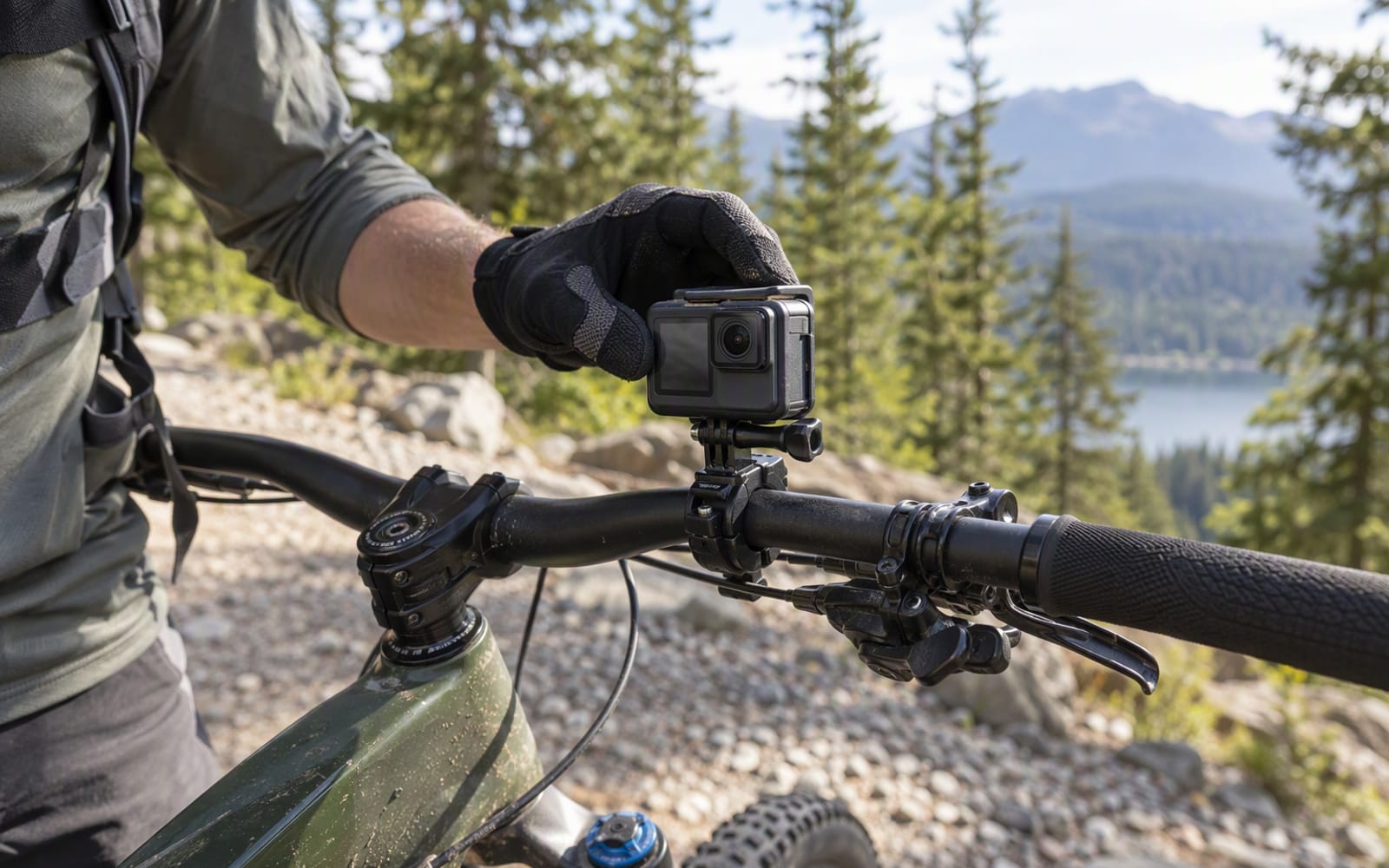
- Mounting. Clamped to a frame, strapped to a chest, stuck to a helmet, bolted to a wing mirror. The mounting ecosystem exists because these cameras are small, light and shaped to be attached.
- Cold. Cold reduces battery life for everything, but an action camera can be kept warm in a pocket between shots and swapped in seconds. A phone that shuts down in the cold takes your navigation with it.
- Crash risk. If the camera might be destroyed, you want the cheaper, tougher, replaceable device on the bars. That is an insurance argument, and it is a good one.
Rule of thumb: buy the camera by the mounts you can get for it, not by the sensor inside it. A camera that mounts nowhere films nothing, and the accessory ecosystem decides how many places you can actually put it.
The mounting ecosystem is the real product
This is the part most buyers miss. When you buy into the largest action camera ecosystem, you are buying into a decade of standardised fittings, which means a clamp, a suction cup or a chest harness is available cheaply and almost anywhere. The newer magnetic quick-release systems from the other brands are well designed and faster to use, but they are younger, and third-party options are fewer and often pricier.
If you already own mounts, or you plan to attach the camera in unusual places, that compatibility is worth more than any specification on the box. If you will use one mount in one place, it matters much less.
Battery and card management
Action cameras run on small batteries, and high-bitrate modes drain them quickly. Plan on carrying spares and swapping them mid-session rather than expecting one battery to cover a day. Cold weather shortens runtime further, so keep spares in an inside pocket.
Storage fills fast, too. High-bitrate footage consumes card space at a rate that surprises people who are used to phone video, so buy cards with headroom and offload them regularly rather than letting a card fill mid-trip. Both of these are management habits, not product features, and they are the difference between a camera that works and one that fails on the day.
Our picks
Three action cameras, each strongest in a different condition. As always, note what you give up.
A note on how we choose. Techowire does not run a test lab. Our recommendations are based on manufacturers’ published specifications compared against the scenario you are reading about, plus a consistent editorial judgement about which trade-offs matter. We do not publish star ratings or claim hands-on measurements. Where a claim is inference rather than a verified fact, the wording says so.
GoPro HERO13 Black — for harsh conditions
The reason to pick this one is the ecosystem as much as the camera. It is waterproof without a housing, has replaceable lens glass, and uses the most widely supported mounting standard in the category. Based on published specifications, its stabilisation is built for fast movement, and the magnetic mounting system makes swapping between mounts quick.
What you give up: battery life is limited in cold weather and at the highest settings, low light is its weakest area, and some cloud features sit behind a subscription.
DJI Osmo Action 5 Pro — for long days and cold
Where the GoPro wins on mounts, this wins on endurance and low light. Based on published specifications it has the strongest battery rating in the class, a larger sensor that improves low-light footage, and dual screens that make framing yourself much easier. The magnetic quick-release mount is fast to use.
What you give up: the mounting ecosystem is younger than the alternative, accessories tend to cost more, and the highest-bitrate modes fill cards quickly.
Insta360 Ace Pro — for low light and self-filming
A larger sensor and a flip-up screen make this the choice if much of your footage happens after sunset or if you film yourself talking to camera. Based on published specifications it is water resistant without a housing, with good stabilisation and a magnetic quick-release mount.
What you give up: its depth rating is lower than the diving-oriented alternatives, the accessory ecosystem is smaller, and it sits at the premium end of the category.
Comparison table
| GoPro HERO13 Black | DJI Osmo Action 5 Pro | Insta360 Ace Pro | |
|---|---|---|---|
| Strongest at | Mounts and harsh conditions | Battery endurance and cold | Low light and self-filming |
| Waterproof without housing | Yes | Yes | Water resistant, lower depth rating |
| Mounting system | Long-established standard | Magnetic quick-release | Magnetic quick-release |
| Screens | Standard layout | Dual screens | Flip-up screen |
| Main trade-off | Battery in cold; low light | Younger ecosystem; accessory cost | Smaller ecosystem; premium cost |
What not to overpay for
- Higher resolution modes. They fill cards and batteries faster, and most viewers watch on a phone screen.
- A camera for a holiday you are not taking. If the trip is dry and gentle, your phone is the camera.
- Every mount in the catalogue. Buy the two mounts your actual activity needs and ignore the rest.
- A subscription you will not use. Cloud backup is convenient, not essential. Local cards work.
When you should not buy anything
If your filming is dry, daylight, handheld or lightly mounted, the phone is the right tool and an action camera will not improve the result. Spend nothing, and instead buy a decent phone mount and a protective case.
Buy an action camera when you have a specific physical problem a phone cannot solve: water, dust, cold, mounting in an awkward place, or genuine crash risk. That is a real need, and it is the only reason the category exists. Everything else is a phone with extra steps.
Our picks
These are the models we would shortlist for the scenarios in this article. Each entry shows the published specification highlights, what the product is genuinely good at, and what you give up.
GoPro HERO13 Black
GoPro
The camera you take where a phone would die. Waterproof without a case, replaceable lens glass, and a mounting ecosystem that has been standardised for a decade — that ecosystem is as much the product as the camera.
What it does well
- Waterproof out of the box
- Best mounting ecosystem in the category
- Strong stabilisation for fast movement
What to accept
- Battery life is limited in cold or 4K conditions
- Low light is its weakest area
- Subscription needed for some cloud features
Best for: Water sports · Mountain biking · Dusty environments
Published specs: Waterproof action camera without a housing; Interchangeable lens glass; Stabilisation that works at speed; Magnetic mounting system.
Last checked: 2026-09-28
DJI Osmo Action 5 Pro
DJI
Where the GoPro wins on ecosystem, this wins on endurance and low light. Two screens make vlogging framing much easier, and the published battery rating is the best in the class.
What it does well
- Best battery life in the category
- Better low-light footage than rivals
- Front screen makes vlogging easier
What to accept
- Mounting ecosystem is younger than GoPro’s
- Accessories are pricier
- High-bitrate modes fill cards fast
Best for: Long rides · Travel vlogging · Cold weather
Published specs: Waterproof action camera with dual screens; Large sensor for improved low light; Magnetic quick-release mounting; Long published battery rating.
Last checked: 2026-09-28
Insta360 Ace Pro
Insta360
A larger sensor and a flip-up screen make this the action camera to choose if much of your footage happens after sunset or if you film yourself. It is less waterproof at depth than the diving-oriented alternatives.
What it does well
- Clearly better low-light footage
- Flip screen makes framing easy
- Good stabilisation
What to accept
- Depth rating lower than the diving-oriented rivals
- Accessory ecosystem is smaller
- Premium price
Best for: Evening rides · Indoor action · Vlogging
Published specs: Action camera with a large sensor; Flip-up touchscreen for self-filming; Magnetic quick-release mount; Water resistant without a housing.
Last checked: 2026-09-28
Frequently asked questions
Is an action camera better than a phone for video?
Not in image quality, and not for most people. A modern phone usually has the larger sensor and the stronger processing, which matters most as light drops. An action camera wins on physical robustness and mounting, not on picture. Buy one for the situations a phone cannot survive, not for better-looking footage.
Do I need an action camera for cycling?
Only if the conditions are the point. A phone in a handlebar mount records a commute perfectly well in dry weather. The action camera earns its place in rain, on wet gravel, in dust, in the cold, or if you ride in a way where a crash is likely. If your rides are dry and gentle, the phone is the better tool.
How many batteries should I carry?
More than you think. Action cameras use small cells and high-bitrate modes drain them quickly, especially in cold weather. For a day out, plan on swapping batteries and carry spares in a warm pocket. Cold reduces usable runtime, so a battery that lasts a full session indoors may fall short on a winter ride.
Are the mounts more important than the camera?
For action cameras, yes. A decade of standardised mounts exists for the largest ecosystem, which means a cheap clamp, suction cup or chest harness is available almost anywhere. The other systems use their own quick-release fittings, which work well but offer fewer third-party options. Choose the camera by the mounts you can buy for it.
Related

Cameras
Best Webcams for Working From Home
Lighting, sensor size and privacy matter more than resolution. Here is how to choose a webcam for a spare-room office, and which three models we would shortlist.
Cameras
Best Microphones for Podcasting at Home
An untreated room decides which microphone suits you. Here is how dynamic and condenser capsules differ, and which three home models we would shortlist.

Cameras
Ring Lights vs Softboxes: A Beginner's Lighting Guide
Ring lights give flat, shadowless light; softboxes let you shape a scene. Here is how to choose your first light, and when a window does the job for free.