Audio & Headphones · Comparison
If you are choosing between two headphones and one is open-back while the other is closed, you are not really comparing two products. You are choosing between two different relationships with the room you are sitting in. Everything else — brand, price, driver size — is a detail by comparison.
This is the decision most buyers make by accident, and it is the one that most often produces disappointment.
The physical difference
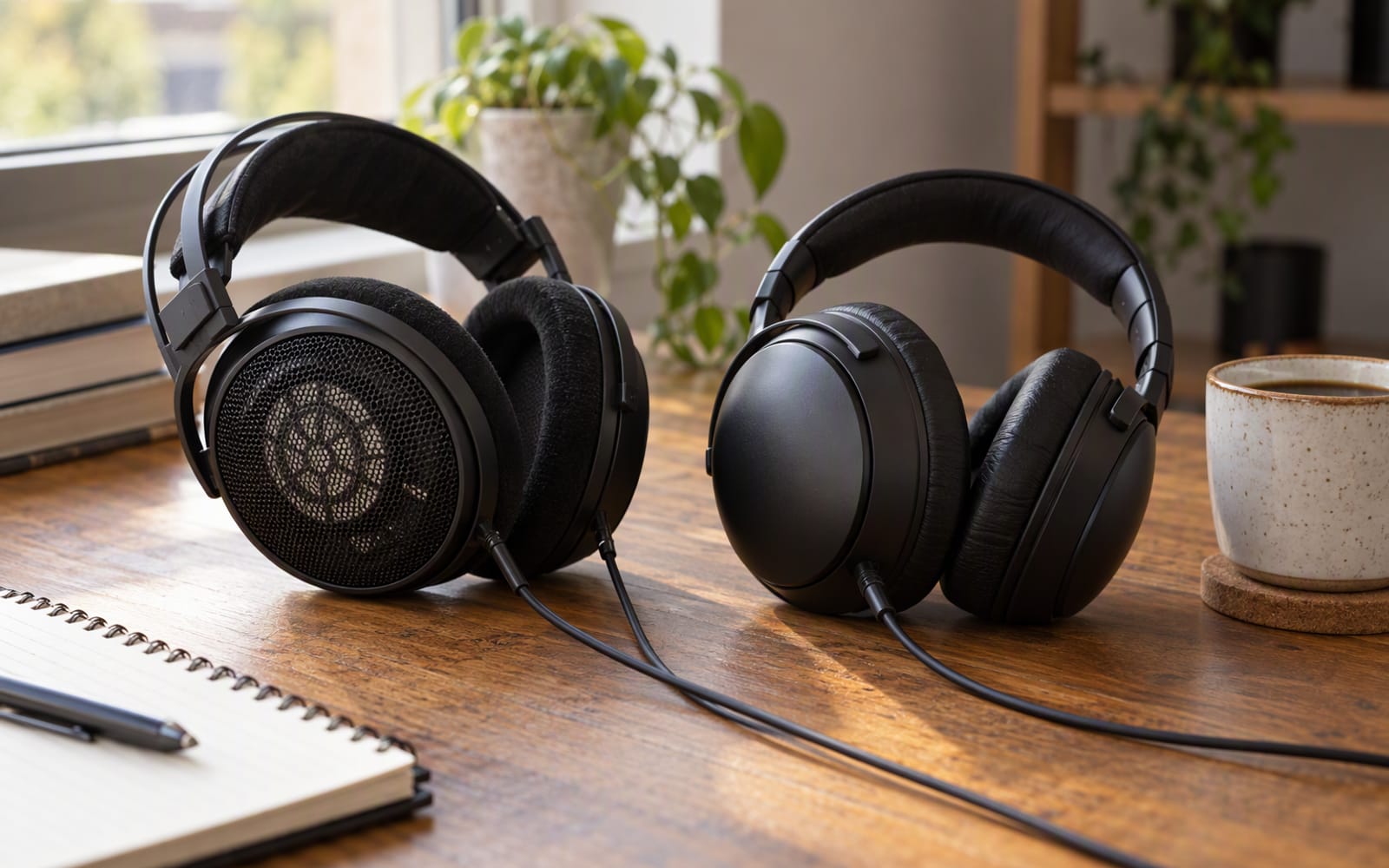
Closed-back headphones have a solid, sealed cup. The driver fires into an enclosed volume, and the seal between the pad and your head is what keeps sound in and noise out.
Open-back headphones have a grille, mesh or perforated panel on the outside of the cup. Air moves freely in and out. Nothing is sealed, in either direction.
That is the whole mechanical difference, and it produces every consequence below.
Side by side
| Closed-back | Open-back | |
|---|---|---|
| Isolation from room noise | Good to excellent, depends on the seal | Essentially none |
| Sound leakage outward | Low at sensible volumes | Significant — people nearby hear it |
| Soundstage and sense of space | Narrower, more “in your head” | Wider, more speaker-like |
| Bass extension and impact | Usually stronger and more physical | Usually lighter, more controlled |
| Ear fatigue over long sessions | Can build up from heat and pressure | Very low — ears stay cool and open |
| Typical use case | Commuting, office, tracking, travel | Quiet-room listening, mixing, long sessions |
| Amplification needs | Usually easy to drive | Varies widely; some need an amp |
What open-back actually gives you
The reason engineers and long-session listeners gravitate to open-back designs is that removing the enclosed air removes a whole class of acoustic problems. The sound bouncing around inside a closed cup arrives at your ear slightly late and slightly coloured. Open the cup and most of that disappears.
The practical result is a presentation that feels wider and less congested. Instruments separate more easily. You can listen for hours without the sensation of pressure building in your ears.
What you pay for it is everything in the “isolation” row of that table.
What closed-back actually gives you
Closed-back headphones are the practical choice for most people most of the time, because most people do not have a dedicated quiet room. The sealed cup gives you a private listening space anywhere: on a train, at a shared desk, in a flat with thin walls.
Closed cups also tend to deliver more bass weight, partly because the sealed volume reinforces low frequencies and partly because isolation lets you hear the low end without turning the volume up.
The cost is the reflections inside the cup, a narrower soundstage, and warmer ears over a long session.
The leakage question, honestly
Manufacturers rarely state leakage figures, and reviewers often underplay it. Here is the practical reality: at a normal listening volume, someone sitting next to you will hear open-back headphones clearly enough to identify the track. At a loud volume, someone across a room will.
If that matters — open-plan office, library, shared bedroom, a sleeping partner — closed-back is not a preference, it is a requirement.
Which one should you buy?
The one-line rule: if you share your space with anybody — a colleague, a flatmate, a partner, a sleeping child — buy closed-back. Open-back is a privilege of having a door you can close.
Work through your situation:
- You commute, work in a shared space, or travel. Closed-back. There is no version of this where open-back works.
- You have a quiet room and listen for long stretches. Open-back, and the difference is genuinely worth experiencing.
- You record or monitor audio. Closed-back for tracking, because open-back leaks into the microphone. Many engineers keep both.
- You want bass impact above all. Closed-back, and specifically a closed model known for low-end extension rather than one chosen for neutrality.
- You are unsure. Closed-back. It is the safer default, it works everywhere, and it will not become useless the moment your living situation changes.
Our picks
One open-back and two closed-back models, covering the three most common reasons people end up in this category.
The open-back option is the cheapest way into the format, and it is efficient enough to run from a laptop without a separate amplifier — which matters, because needing an amplifier on top of the headphones turns a cheap decision into an expensive one. It is also the model that shows most clearly what open-back buys you: a wide, uncongested presentation that closed cups cannot reproduce.
The two closed-back options split by purpose rather than price. One is wireless and built for everyday listening and calls, which makes it the practical choice if the headphones will leave the house. The other is wired, isolates better, and is designed around long studio sessions and replaceable parts — the right answer if the headphones live at a desk and you want to still be using them in a decade.
Neither is a compromise pick. They are simply built for different rooms.
A note on driving them
Impedance gets quoted constantly and it is only half the story. Sensitivity determines how much output you get for a given input, and a low-impedance, low-sensitivity headphone can be harder to drive than a high-impedance, high-sensitivity one.
As a rough guide: if your headphones sound thin, quiet or dynamically flat from a laptop or phone dongle, that is the signal you need an amplifier — not a review telling you the impedance number. If they sound full and loud enough at 60 per cent volume, you do not.
The short verdict
Closed-back is the right answer for most people, most of the time, and it is the only answer if you share your space with anyone. Open-back is a deliberate choice for a quiet room, and if you have that quiet room, it is a choice worth making.
Our picks
These are the models we would shortlist for the scenarios in this article. Each entry shows the published specification highlights, what the product is genuinely good at, and what you give up.
Sennheiser HD 560S
Sennheiser
The cheapest way into genuinely good open-back sound. Open-back means a wide, airy presentation and zero ear fatigue — and also means everyone in the room hears your music, and you hear them.
What it does well
- Wide soundstage that closed-backs cannot match
- Very light and comfortable for hours
- Drives acceptably from a laptop or dongle
What to accept
- Leaks sound in both directions
- No isolation at all — unusable in an office
- Needs a quiet room to be worth it
Best for: Quiet rooms · Long listening sessions · Mixing at a desk
Published specs: Over-ear, open-back, wired only; Detachable cable; Low impedance, so a phone dongle can drive it; Replaceable earpads.
Last checked: 2026-09-18
Audio-Technica ATH-M50xBT2
Audio-Technica
A studio staple with Bluetooth added. The closed-back design keeps sound in and noise out, the cable option means zero latency when you need it, and the sound is deliberately flat rather than flattering.
What it does well
- Honest, uncoloured sound for editing
- Wired mode removes Bluetooth latency entirely
- Very long battery rating
What to accept
- No active noise cancelling
- Bulky for travel
- Clamp force is firm out of the box
Best for: Audio editing · Home studio · Wired and wireless use
Published specs: Over-ear, closed-back, wired and Bluetooth; Detachable cable for latency-free monitoring; Flat, monitor-style tuning; Published battery rating around 50 hours.
Last checked: 2026-09-18
Beyerdynamic DT 770 PRO
Beyerdynamic
A studio standard that has barely changed in decades because it does not need to. The closed cup isolates well, the velour pads stay comfortable for hours, and the sound is honest rather than flattering.
What it does well
- Strong passive isolation for a wired headphone
- Comfortable for very long sessions
- Almost every part is user-replaceable
What to accept
- No Bluetooth and no active noise cancelling
- High-impedance versions need an amplifier
- Fixed cable on some variants
Best for: Tracking and recording · Noisy shared rooms · Long sessions
Published specs: Over-ear, closed-back, wired only; Velour earpads and a padded steel headband; Available in several impedance variants; Replaceable pads, cable and headband.
Last checked: 2026-09-18
Frequently asked questions
Can I use open-back headphones in an office?
Technically yes, practically no. Open-back headphones leak sound outward at normal listening volumes, so anyone within a couple of metres hears your audio. They also let all of the room noise in, which means you lose both privacy and isolation at once. Open-backs belong in a quiet room where you are not disturbing anyone.
Do open-back headphones sound better?
They sound more open, which is a specific and describable quality rather than a general improvement. Because the driver is not enclosed, reflections inside the cup are largely eliminated, which usually produces a wider sense of space and a lighter, airier presentation. Whether that is 'better' depends entirely on what you are listening for. For bass-heavy music and monitoring, closed-back is often the more useful choice.
Which is better for gaming?
It depends on the game. Open-back headphones give a wider, more directional soundstage that helps with positional audio in competitive shooters. Closed-back headphones isolate you from a noisy room and keep the sound in, which is better for shared living spaces. Neither is universally correct.
Do I need an amplifier for open-back headphones?
Not necessarily, but it depends on the model. Impedance and sensitivity together determine how hard a headphone is to drive, and impedance alone is a poor guide. Many modern open-back designs are efficient enough to run from a laptop or a USB-C dongle. High-impedance studio models generally benefit from a dedicated amplifier.
Related

Audio
Best Noise-Cancelling Headphones for Open-Plan Offices
Open-plan offices are the hardest listening environment there is. Here is how to choose noise-cancelling headphones for a shared desk, and which models we would shortlist.

Audio
Wireless Earbuds for Running: What Actually Stays In Your Ears
Fit and retention decide whether running earbuds survive a 5K, not sound quality. How to choose for your ear shape, sweat, and traffic awareness.

Audio
Best Budget Wireless Earbuds Under $100 for Commuters
What you actually give up on budget commuter earbuds — wind-hit microphones, plain apps, shallow ANC — and why that trade is usually the right one.