
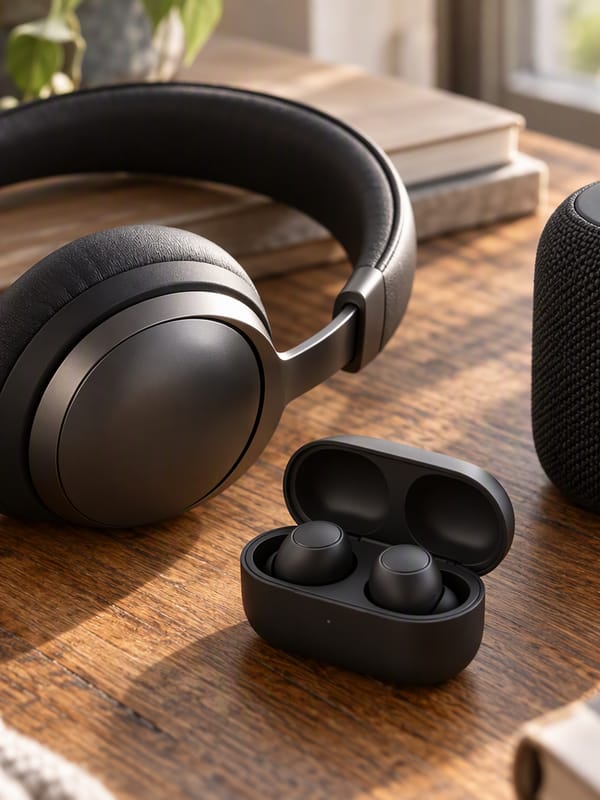
Audio & Headphones · Buying guide
Open-plan offices are the hardest environment to listen in, and it is worth understanding why before you spend anything. There are three different noises hitting you at once: the constant low rumble of ventilation and traffic, the mid-frequency murmur of a room full of people, and the sharp transients of someone dropping a mug or laughing two desks over. Noise cancelling headphones handle those three problems to very different degrees.
That mismatch is where most buying advice goes wrong. A headphone can be genuinely excellent at one and mediocre at the others.
What noise cancelling can and cannot do
Active noise cancelling works by sampling the sound around you with small microphones and playing back an inverted copy of it. That works beautifully on steady, predictable, low-frequency sound. It works poorly on anything sudden or high-pitched, because the system has to predict the waveform before it reaches your ear.
In practice, for an open-plan office this means:
- Air conditioning, traffic, fan noise, aircraft cabin roar — cancellation is dramatic and obvious. This is the case ANC was designed for.
- A distant general murmur of conversation — partially reduced. The room feels quieter but does not go away.
- Someone talking clearly within a few metres — barely touched. You will still hear the words.
- A phone ringing, a door slamming, cutlery on a plate — untouched, and sometimes emphasised.
The honest conclusion is that for speech you are relying on passive isolation — the physical seal of the earcup or ear tip — far more than on the electronics. That is why an over-ear headphone with a good clamp and thick pads can outperform a technically superior ANC system in a real office.
Here is how the three office noises actually behave:
| Office noise | What handles it | How well it works |
|---|---|---|
| Ventilation hum, traffic, fan noise | Active noise cancelling | Very well — this is what ANC is designed for |
| General room murmur of a busy floor | ANC plus earcup seal | Partially — the room feels quieter but does not disappear |
| Clear speech within a few metres | Passive isolation only | Poorly — you will still hear the words |
| Sudden transients: a dropped mug, a door, a phone ringing | Nothing much | Untouched, and sometimes emphasised |
The four things that actually matter
1. Passive isolation and fit
An over-ear headphone that seals properly around your ear blocks a useful amount of mid-frequency sound before any electronics switch on. This is why fit and pad depth matter more than the ANC spec. If the earcups sit on your ears rather than around them, or the headband does not clamp enough to seal, you lose this for free.
If you wear glasses, be aware that the arms break the seal at the temple. A slightly firmer clamp helps, but a headphone that clamps hard enough to seal over glasses will usually be uncomfortable after two hours.
2. Comfort over eight hours
This is the specification nobody publishes and the one that decides whether you actually use the thing. Look for a headband that distributes weight across the top of your head rather than concentrating it, and earcups deep enough that your ear does not touch the driver grille.
As a rough guide, anything over about 300 g starts to make itself known by mid-afternoon.
3. Multipoint pairing
If you take calls on a phone while working on a laptop, multipoint is worth more than a marginal ANC improvement. It keeps both devices connected, so your laptop audio pauses when a call arrives instead of forcing you to dig through Bluetooth settings.
4. Microphone quality on calls
Your colleagues hear your microphone, not your noise cancelling. Beam-forming microphone arrays with wind rejection matter far more on a video call than the cancellation rating. This is the single most common disappointment with otherwise excellent headphones.
Our picks
We have shortlisted three models for three different office realities. Each entry lists the published specification highlights the recommendation rests on, and — importantly — what you give up.
A note on how we choose. Techowire does not run a test lab. Our recommendations are based on manufacturers’ published specifications compared against the scenario you are reading about, plus a consistent editorial judgement about which trade-offs matter. We do not publish star ratings or claim hands-on measurements. Where a claim is inference rather than a verified fact, the wording says so.
How to choose in five minutes
Work through this in order and you will land on the right shortlist quickly.
- Is speech your main problem? If yes, prioritise passive isolation and fit, and consider in-ear models with a deep seal. ANC is a secondary benefit here.
- Is it steady noise — ventilation, traffic, an open window? ANC is the right tool, and the differences between good models become small. Buy for comfort.
- Do you switch between a laptop and a phone all day? Multipoint is close to mandatory. Filter your shortlist by it first.
- Do you wear glasses? Test clamp force before you commit. A firmer headphone is more likely to seal, and more likely to hurt.
- Do you travel with them? A folding design and a hard case change how often you actually carry them. A headphone left at home cancels nothing.
What not to overpay for
- Spatial or immersive audio modes. These are impressive in a demo and frequently switched off permanently. They are not a reason to pay more for office use.
- Hi-res codec support. In a noisy office, ambient noise masks far more detail than any codec difference reveals. Codec support matters in a quiet room, not a busy one.
- A slightly better ANC figure. Once cancellation is good, the incremental gains are small compared with the comfort difference between two models.
- The newest generation. Successor models mostly improve microphones and comfort. If the previous model fits you well, it is often the smarter purchase.
When you should not buy anything
If your actual problem is one specific colleague, noise cancelling headphones are an expensive workaround for a conversation. If your problem is a building-wide ventilation hum, they are exactly the right tool. Being honest about which of those you have will save you a few hundred.
And if you already own a decent pair of over-ear headphones with a good seal, the upgrade to an ANC model is a comfort and convenience purchase rather than a transformation. That is a perfectly good reason to buy — just make the decision knowing what you are buying.
Our picks
These are the models we would shortlist for the scenarios in this article. Each entry shows the published specification highlights, what the product is genuinely good at, and what you give up.
Sony WH-1000XM5
Sony
The most complete noise-cancelling package for shared spaces: strong low-frequency cancellation, a light clamp force you can wear for a full working day, and multipoint pairing so you can jump between a laptop and a phone without re-pairing.
What it does well
- Excellent cancellation of air-conditioning and road hum
- Very light for an over-ear ANC model
- Speak-to-chat and auto-pause work well in practice
What to accept
- Does not fold into a compact ball like the previous generation
- The earcups can get warm in summer
- Premium price bracket
Best for: Open-plan offices · Long flights · Focus work at home
Published specs: Over-ear, closed-back, active noise cancelling; Multipoint Bluetooth pairing; Rated up to 30 hours with ANC on (published specification); Foldable flat for a laptop bag.
Last checked: 2026-09-18
Bose QuietComfort Ultra Headphones
Bose
If the single job is making a constant roar disappear — engines, traffic, a neighbour’s renovation — this is the model to shortlist. Immersive Audio adds a spatial mode that some listeners love and others switch off permanently.
What it does well
- Class-leading steady-noise cancellation
- Very comfortable clamp for long sessions
- Simple, readable physical buttons
What to accept
- Spatial mode colours the sound noticeably
- Case is bulkier than the Sony equivalent
- Costs more than most people need to spend
Best for: Long-haul flights · Train commutes · Very noisy homes
Published specs: Over-ear, closed-back, active noise cancelling; Adjustable quiet / aware / immersive modes; Published battery rating around 24 hours with ANC; Physical controls plus app customisation.
Last checked: 2026-09-18
Soundcore Space A40
Soundcore
The earbuds to buy when you want competent ANC and a long battery rating without spending flagship money. You give up a little refinement in the app and microphone quality on windy calls.
What it does well
- ANC that is genuinely useful at this price
- Very small case
- Long battery rating
What to accept
- Call quality drops in wind
- App has more settings than most people need
- Treble can sound sharp on some tracks
Best for: Budget buyers · Commuting · Second pair for a bag
Published specs: In-ear true wireless with adaptive ANC; Published battery rating around 8 hours, more with the case; Wireless charging case; Compact, low-profile shape.
Last checked: 2026-09-18
Frequently asked questions
Does noise cancelling actually block nearby conversation?
Partly, and less than most people expect. Active noise cancelling is very good at steady, low-frequency sound — air conditioning, road hum, aircraft engines. Human speech sits in a higher frequency range where cancellation is much weaker, and unpredictable speech is the hardest case of all. If your main problem is a colleague on a call two metres away, passive isolation from a well-sealed over-ear headphone does more work than the electronics.
Over-ear or in-ear for an office?
Over-ear, unless you need to disappear into a pocket. Over-ears give you more passive isolation from the earcup seal, more comfort across a full working day, and a battery you charge weekly rather than daily. In-ears win on portability and on how well they block speech, because they seal inside the ear canal.
Is multipoint Bluetooth worth insisting on?
Yes, if you work across a laptop and a phone. Multipoint lets both stay connected at once, so a call on your phone pauses your laptop audio instead of forcing you to re-pair. It is one of the few features in this category that changes your day rather than your spec sheet.
Should I buy the newest model?
Not automatically. Each generation tends to improve comfort and microphone quality more than raw cancellation. If a previous-generation model is still on sale and the fit suits you, it is often the better value — the physics of cancelling steady noise has not changed much.
Related
Audio
Open-Back vs Closed-Back Headphones: Which Should You Buy?
The single biggest decision in headphone buying is not the brand or the price. It is whether the cups are open or closed. Here is how the choice changes everything.

Audio
Wireless Earbuds for Running: What Actually Stays In Your Ears
Fit and retention decide whether running earbuds survive a 5K, not sound quality. How to choose for your ear shape, sweat, and traffic awareness.

Audio
Best Budget Wireless Earbuds Under $100 for Commuters
What you actually give up on budget commuter earbuds — wind-hit microphones, plain apps, shallow ANC — and why that trade is usually the right one.