Travel Tech · Buying guide
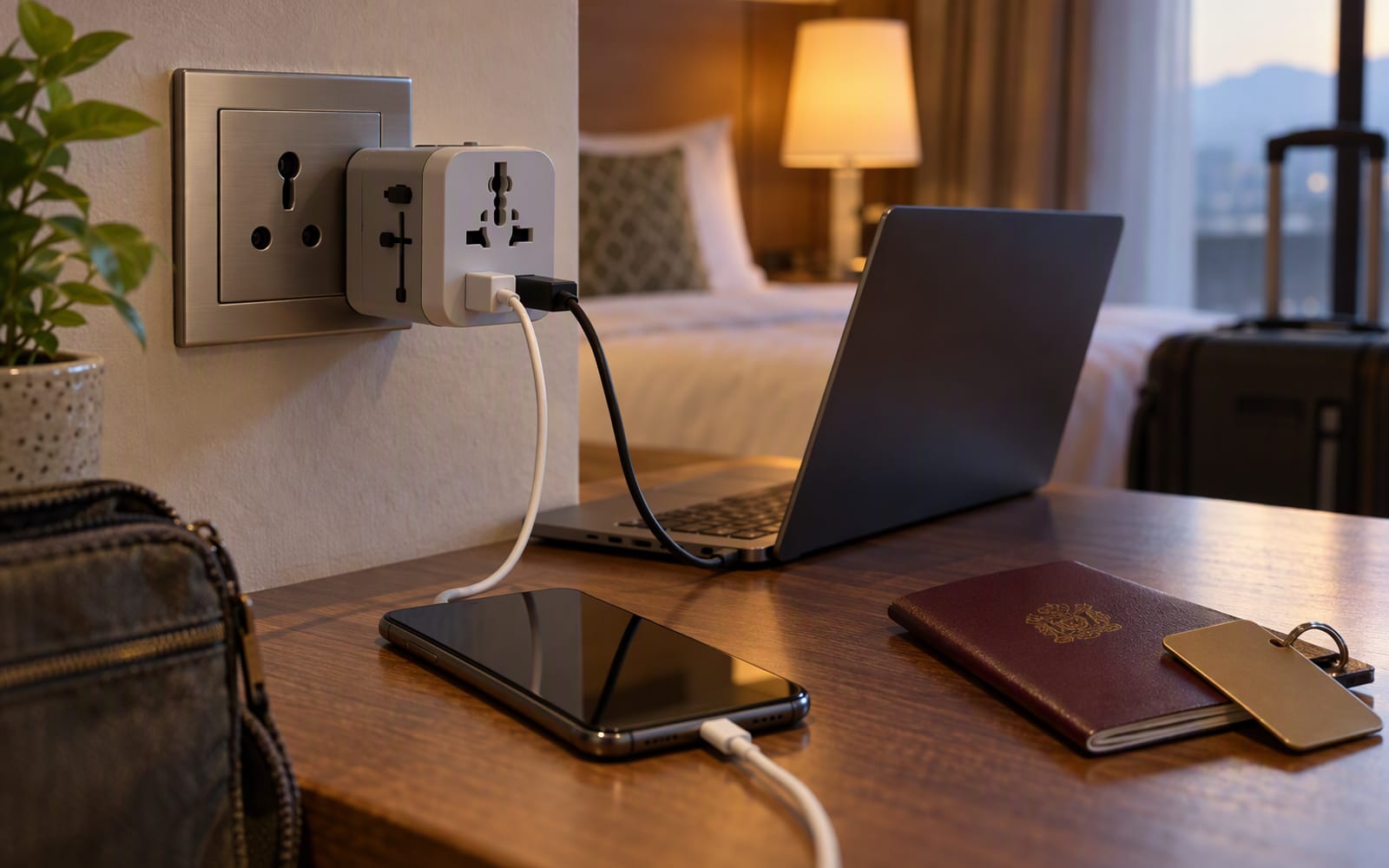
Every hotel room has the same layout: one accessible socket, behind the bed, already occupied by a lamp, and a two-week trip in a carry-on that has to charge a phone, a laptop, a watch and a camera from it. That is the situation travel adapters exist for, and it is also where a lot of people buy the wrong thing, because they buy a shape and expect a power supply.
What an adapter does, and does not do
An adapter changes the shape of the plug. That is the entire function. It does not change the voltage coming out of the socket.
For most travellers this distinction never matters, because modern chargers are dual-voltage and accept the full range of mains voltages used around the world. Check the small print on your charger; if it lists a voltage range rather than a single figure, it is dual-voltage and a plug adapter is all you need.
Where it does matter is appliances that are not chargers: hair dryers, travel kettles, some older shavers, anything with a heating element or a motor. These are often built for a single voltage. A plug adapter will let you plug one in, and it will either underperform or be damaged. Those need a voltage converter, which is a separate, heavier and more expensive product — and for most trips the honest answer is to leave the appliance at home.
An adapter is a shape-changer. The device behind it still expects the voltage it was built for.
Single-region or universal
Universal adapters carry retractable pins for most of the world’s socket types in one body. They are the right choice if a trip crosses borders, if one adapter has to serve several people in a shared room, or if you genuinely do not know where you will end up next. The costs are bulk and complexity: more mechanism to fail, more weight in the bag, and usually a modest total output across the USB ports.
Single-region adapters cover one socket standard. They are smaller, lighter, more robust, and easier to trust. If you fly to the same country repeatedly — a regular work route, family in one place — a single-region adapter is the better tool, and the universal one is just extra hardware you are carrying for no reason.
Do you need laptop-class USB-C output
If a laptop travels with you, this is the question that decides the purchase.
Most travel adapters have USB ports, but the total output across them is modest. A phone and a watch are fine. A laptop is not, because charging a laptop needs a decent USB-C Power Delivery output that a basic adapter cannot provide.
There are two honest outcomes. Either you buy an adapter that delivers laptop-class USB-C power, in which case it replaces both your adapter and your laptop charger and earns its extra weight. Or you accept that the adapter is only a socket, carry the laptop’s own charger, and use the adapter for everything else. The second option is perfectly reasonable — just recognise that the adapter’s USB ports are not doing the job you imagined.
The shared-wattage trap
Multi-port adapters and chargers share their total output across the ports. Plug in four things and each one gets less than it would alone, and the figure printed on the box is usually the maximum total rather than what any single port receives.
Read the port allocation before you buy, not the headline number. An adapter advertised at a high total wattage may still deliver very little to the port your laptop is plugged into when three other devices are charging at the same time.
Fuses and the false economy
A very cheap adapter with no fuse has nothing to sacrifice if something goes wrong. A fuse is a deliberate weak point that fails first, so the failure stops inside the adapter instead of travelling into your device or the building’s wiring.
On a product you will plug into an unfamiliar wall, in an unfamiliar building, in a country whose electrical standards you have not checked, that fuse is the whole reason the product is worth having. Saving money by removing it is the definition of a false economy.
Our picks
EPICKA Universal Travel Adapter — the all-in-one answer. Retractable plugs covering most international socket types, multiple USB-A and USB-C ports, and a built-in safety fuse. Best for multi-country trips and for a family or group sharing one adapter in a hostel. What you give up: it does not convert voltage, it is bulky once it is in the socket, and its total USB wattage is modest.
Zendure Passport III Pro — the one that charges the laptop. A universal adapter that also delivers enough USB-C power to run a laptop, which most travel adapters cannot, so it replaces both an adapter and a charger. Best for laptop travellers and frequent flyers. What you give up: it is heavier than a simple adapter, it costs more, and it runs warm under sustained high-wattage load.
Anker 312 Travel Adapter — the specialist. A compact single-region adapter with USB-C and USB-A charging ports and built-in safety features. Best if you travel repeatedly to one country and want the smallest possible thing in your bag. What you give up: coverage, since it handles one region only, and output, since the total wattage is low.
| EPICKA Universal | Zendure Passport III Pro | Anker 312 | |
|---|---|---|---|
| Coverage | Most countries in one unit | Most countries in one unit | One region |
| Laptop-class USB-C | Limited | Yes | No |
| Fuse | Yes | Yes | Built-in safety features |
| Best for | Multi-country trips and shared rooms | Laptop travellers | Repeated trips to one country |
| What you give up | Bulk and modest wattage | Weight and cost | Coverage and output |
What not to overpay for
- A built-in voltage converter. Converters are heavy, and most travellers never need one. If you do, buy it as a separate product you can leave at home when you do not.
- More USB ports than devices. Extra ports you never use are just weight and another thing to share wattage with.
- Brand-matching your laptop. The socket does not care whose logo is on the adapter.
- A universal adapter for a single-country trip. You are paying for pins you will never extend.
When you should not buy anything
If every device you carry is dual-voltage and you already own a compact multi-port charger, you may only need a simple plug adapter — and a cheap, well-made one with a fuse is genuinely all that is required.
And if you are not travelling, do not buy a travel adapter. It is a single-purpose product, and the models that look useful on a product page are the ones that gather dust in a drawer until the trip you have not booked yet.
Our picks
These are the models we would shortlist for the scenarios in this article. Each entry shows the published specification highlights, what the product is genuinely good at, and what you give up.
EPICKA Universal Travel Adapter
EPICKA
One adapter that covers most of the world and includes USB ports so you can leave separate chargers at home. It does not convert voltage, which is the detail most people get wrong.
What it does well
- Covers a wide range of countries in one unit
- USB ports reduce the number of chargers you pack
- Compact and self-contained
What to accept
- Does not convert voltage
- Bulky in a socket
- Total wattage is modest
Best for: Multi-country trips · Families sharing one adapter · Hostels
Published specs: Universal travel adapter with retractable plugs; Multiple USB-A and USB-C ports; Covers most international socket types; Built-in safety fuse.
Last checked: 2026-10-06
Zendure Passport III Pro
Zendure
A universal adapter that also delivers enough USB-C power to charge a laptop, which most travel adapters cannot. Heavier than a basic adapter, and worth it if a laptop comes with you.
What it does well
- Charges a laptop from a foreign socket
- Replaces a charger and an adapter
- Solid build
What to accept
- Heavier than a simple adapter
- Expensive
- Warm under sustained high-wattage load
Best for: Laptop travellers · Long trips · Frequent flyers
Published specs: Universal travel adapter with high-wattage USB-C; Multiple device charging; Covers most international socket types; Compact for its output.
Last checked: 2026-10-06
Anker 312 Travel Adapter
Anker
A simple, well-made adapter for one region rather than the world. If you travel to the same country repeatedly, a single-region adapter is smaller, cheaper and less to go wrong than a universal one.
What it does well
- Very small and light
- Cheaper than a universal adapter
- Reliable build
What to accept
- Only covers one region
- Low total wattage
- Does not convert voltage
Best for: Single-country trips · Phone charging · Occasional travel
Published specs: Compact regional travel adapter; USB-C and USB-A charging ports; Compact body; Built-in safety features.
Last checked: 2026-10-06
Frequently asked questions
Do travel adapters convert voltage?
No. An adapter changes the shape of the plug so it fits a foreign socket; it does not change the voltage coming out of that socket. Most phone and laptop chargers are dual-voltage and are fine, but single-voltage appliances such as hair dryers and travel kettles need a proper voltage converter, which is a different and much heavier product.
Should I buy a universal adapter or a single-region one?
Universal if your trips cross several countries, or if one adapter has to serve a family or a shared room. Single-region if you fly to the same country repeatedly, because it is smaller, lighter and has fewer moving parts to fail.
Can I charge a laptop from a travel adapter?
Sometimes, and it depends on the adapter. Many travel adapters have a modest total output across their USB ports, which is not enough for a laptop. If your adapter does not deliver laptop-class USB-C power, you will carry the laptop's own charger and use the adapter only as a socket, which means the adapter is not really replacing anything.
Why does a fuse matter on a travel adapter?
A fuse is a deliberate weak point designed to fail first if something goes wrong, rather than letting the failure travel into the device or the socket. A very cheap adapter with no fuse has nothing to sacrifice. On a product you will plug into an unfamiliar wall in an unfamiliar building, that is the whole safety story.
Related

Travel
Flying With Headphones: Noise Cancelling vs Isolation
Engine drone is the sound noise cancelling handles best, which is why flights are its showcase. Where ANC stops working, and when earplugs do the job instead.

Audio
Best Noise-Cancelling Headphones for Open-Plan Offices
Open-plan offices are the hardest listening environment there is. Here is how to choose noise-cancelling headphones for a shared desk, and which models we would shortlist.

Audio
Open-Back vs Closed-Back Headphones: Which Should You Buy?
The single biggest decision in headphone buying is not the brand or the price. It is whether the cups are open or closed. Here is how the choice changes everything.