
Smart Home · Buying guide
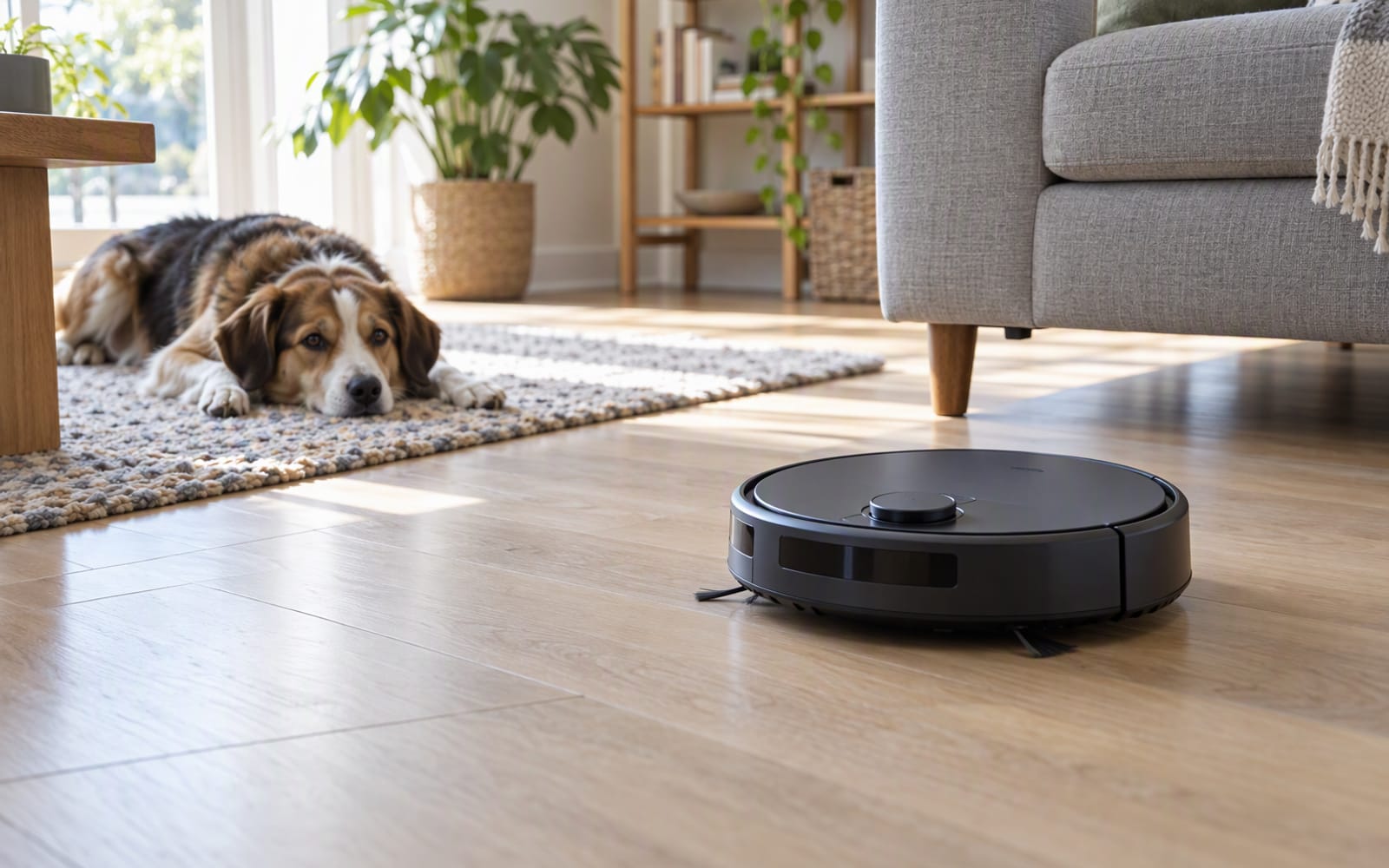
Two dogs, a laminate hallway and a rug in the living room. That is the setup this guide is written for, because it is the one that exposes every weakness in a cheap robot vacuum. A machine that copes with a bit of dust on a hard floor can still fail completely in a home with animals: hair wraps around the brush until it stops turning, the bin fills before the run is finished, and the mop drags a wet line across the one rug in the room.
Pet hair is not simply more dirt. It behaves differently from dust, and it forces a different set of priorities when you choose a machine.
Why pet hair breaks cheap robot vacuums
Dust is light and gets lifted. Pet hair is long, springy and tends to clump. It wraps around anything that rotates, and once a roller is wrapped it stops picking up anything at all. That is why the brush design matters more in a pet household than the suction figure printed on the box.
There is a second problem, and it is the one that decides whether you keep using the machine. Every run leaves you with a full bin and, on some models, a brush you have to cut hair off with scissors. A robot vacuum that needs that much attention after every run ends up in a cupboard. Convenience is not a luxury feature here; it is the difference between a tool you use and an expensive ornament.
The five things that actually matter
1. Brush design and hair tangling. Rubber rollers and dual-brush designs resist hair wrapping far better than traditional bristle brushes. Look for a design the manufacturer explicitly describes as resistant to tangling, and expect to still clean it occasionally.
2. Self-emptying. With pets, the bin fills faster than you expect, and an empty bin is the difference between a machine that runs daily and one that stops mid-room. A self-emptying dock moves the mess into a larger bag that needs changing far less often.
3. Mop behaviour on rugs. If you have any rugs at all, the mop has to get out of the way when it crosses them. A machine that lifts its pad, or lifts the whole mop assembly, handles mixed flooring in one run. One that does not will either soak the rug or force you to set no-go zones around every one.
4. Dock footprint. All-in-one docks are large, and they need clear space plus a power socket. In a small flat this is often the deciding factor, not the vacuum at all.
5. Consumables. Bags, filters, brushes, mop pads and cleaning solution are an ongoing cost for as long as you own the machine. A model with cheap, widely available consumables is easier to live with over several years.
Rule of thumb. With pets, buy for the dock and the brush, not the suction figure. The parts you touch every week decide whether the machine stays in service.
Side by side
| Roborock Qrevo | Eufy X10 Pro Omni | Dreame L20 Ultra | |
|---|---|---|---|
| Hair handling | Dual rubber brushes designed to resist tangling | Standard roller with AI obstacle avoidance | Strong suction aimed at pet hair |
| Dock | Self-emptying and mop-washing | All-in-one: emptying, washing and hot-air drying | Self-emptying and self-washing |
| Mop on rugs | Mixed-floor capable with a mop-washing dock | Better at maintenance cleaning than scrubbing dried spills | Mop pad lifts clear of carpet |
| Footprint | Significant | Large | Very large |
| Best for | Pet households that want reliability | Pet owners watching the budget | Homes with rugs and hard floor together |
Our picks
Prices in this category shift often and vary by retailer, so confirm the current figure with the merchant before you commit. These recommendations rest on published specifications compared against the pet-owner scenario above.
Roborock Qrevo
The one we would pick for a home with animals and hard floors. The combination of a self-emptying dock and a mop that washes itself is what makes the machine worth owning long term, and the dual rubber brushes are the specific design choice that matters when hair is the problem. What you give up is floor space: the dock is large and needs a permanent spot, and it is not a small object in a hallway.
Eufy X10 Pro Omni
The sensible middle option. It delivers the all-in-one dock experience — emptying, washing and hot-air drying — without the premium of the flagship brands, and the obstacle avoidance is good at coping with the cables and shoes a pet household generates. The compromise is navigation that is a step behind the best and a mop that is better at keeping a floor clean than at scrubbing something dried on.
Dreame L20 Ultra
The one to choose if rugs are the sticking point. Its mop pad lifts out of the way on carpet, which is the detail that lets an all-in-one robot cope with a home that is not all hard floor. Suction is aimed squarely at pet hair, and the dock handles emptying and washing. The trade-off is the largest dock of the three and the highest ongoing cost in consumables.
What not to overpay for
- Peak suction figures. Beyond a certain point, the brush design and the bin capacity determine what actually gets picked up.
- A camera-based obstacle system you do not need. It helps with cables and pet accidents, but it is not the reason to choose one machine over another.
- Extra features for a single room. If the machine only ever cleans one open-plan space, a large all-in-one dock is a lot of hardware for the job.
- The newest model at launch. Robot vacuum generations improve incrementally. A previous generation at a lower price is often the better buy.
When you should not buy anything
If your home is mostly carpet with deep pile and the pet hair is worked into it, a robot vacuum is not the right tool. It will pass over the surface and lift what is loose, and you will still need a proper vacuum with a powered brush head. Robots are at their best on hard floors with a few rugs, and that is the honest limit of the category.
Similarly, if the hair problem is one dog in one room, a cordless stick vacuum is cheaper, faster and better at getting into corners. A robot makes sense when the job is repetitive and whole-floor, not when it is occasional.
Our picks
These are the models we would shortlist for the scenarios in this article. Each entry shows the published specification highlights, what the product is genuinely good at, and what you give up.
Roborock Qrevo
Roborock
The combination of a self-emptying dock and a self-washing mop is what makes a robot vacuum worth having long term. Pet hair is the test case where the difference between a cheap and a good model becomes obvious.
What it does well
- Handles pet hair without constant brush cleaning
- Dock empties and washes automatically
- Reliable room mapping
What to accept
- Dock takes up significant floor space
- Needs consumables replaced periodically
- Still requires occasional manual maintenance
Best for: Pet owners · Hard floors with rugs · Busy households
Published specs: Robot vacuum with self-emptying and mop-washing dock; LiDAR navigation with room mapping; Dual rubber brushes resistant to hair tangling; App-based no-go zones and schedules.
Last checked: 2026-09-24
Eufy X10 Pro Omni
Eufy
Gets you the all-in-one dock experience for less than the flagship brands charge. Navigation is a step behind the best, and the mop is better at maintenance cleaning than at scrubbing dried spills.
What it does well
- All-in-one dock at a mid-range price
- Good obstacle avoidance for cables and shoes
- Quiet in standard mode
What to accept
- Mop struggles with dried-on stains
- Navigation slightly less efficient than premium rivals
- Dock is large
Best for: Mixed flooring · Medium homes · Pet owners on a budget
Published specs: Robot vacuum and mop with all-in-one dock; Self-emptying, self-washing and hot-air drying; AI obstacle avoidance; App control with room mapping.
Last checked: 2026-09-24
Dreame L20 Ultra
Dreame
The mop lifts itself out of the way on carpet, which is the detail that makes an all-in-one robot usable in a home with rugs rather than only on hard floors. The dock is large, so plan for the space.
What it does well
- Handles carpet and hard floor in one run
- Strong suction for pet hair
- Genuinely hands-off between maintenance
What to accept
- Very large dock footprint
- Expensive
- Consumables add ongoing cost
Best for: Mixed hard floor and rugs · Large homes · Hands-off cleaning
Published specs: Robot vacuum and mop with all-in-one dock; Mop pad lifting for carpet transitions; LiDAR navigation with obstacle avoidance; Self-emptying and self-washing dock.
Last checked: 2026-09-24
Frequently asked questions
Do I need a self-emptying dock if I have pets?
It is the feature that decides whether you keep using the machine. In a home with animals the bin fills far faster than in a pet-free one, and a robot that stops mid-run because it is full is a robot you stop scheduling. A self-emptying dock moves the collected hair into a larger bag that needs changing far less often.
Will a robot vacuum get tangled in long hair?
It can, and this is why brush design matters more than the suction figure printed on the box. Rubber rollers and dual-brush designs resist hair wrapping much better than traditional bristle brushes, and manufacturers now describe these designs explicitly. Expect to clean the brush occasionally even on a good model.
Can a robot vacuum mop around rugs?
Only if the mop gets out of the way when it crosses carpet. Models that lift the mop pad, or raise the whole mop assembly, can handle mixed flooring in a single run. Models that do not will either wet the rug or force you to draw no-go zones around every one, which quickly becomes tedious.
How often do robot vacuum consumables need replacing?
It depends on how much the machine runs and how much hair it collects, but the cost is ongoing for as long as you own it. Bags, filters, brushes, mop pads and cleaning solution all wear out, and models with cheap, widely available consumables are much easier to live with over several years. Factor this in before choosing between two otherwise similar machines.
Related
Smart Home
Smart Plugs: The Cheapest Way to Start a Smart Home
A smart plug is the cheapest, least disruptive way into home automation. Here is what matters, what to ignore, and which three plugs we would shortlist.
Smart Home
Smart Doorbells for Renters (No Drilling Required)
Battery doorbells let renters add a video doorbell without drilling or an electrician. Here is how to choose one, and where the honest limits are.

Smart Home
Smart Lighting: Bulbs vs Strips vs Panels
Bulbs, strips and panels do three different jobs. Comparing them honestly, including what each one costs you in money, reliability and wall damage.